|
 |
 |
 |
420.0 DESIGN PHASE
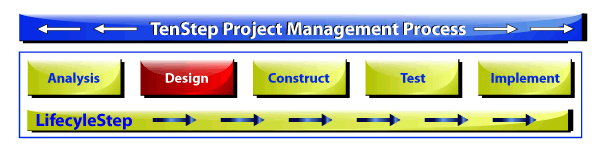
Up to now, the project team and the client have focused on high-level questions regarding the project. These start with simple questions like "why is this solution important?," "what is the business value?" and "what are we going to deliver?" In the Design Phase, these questions are taken to a lower level of detail, and you start to ask the "how" questions. The big one is "how will we build this solution?"
At this point, the project team should have a complete set of requirements to work from, a set of direction-setting strategies and a Conceptual Systems Design. The design process comes next. Even if the project was small and the requirements were simple, there is still a mental design process that occurs in between understanding the requirements and starting to construct. Design becomes more and more important as the project becomes larger and more complex. Once you complete the requirements, you will typically see a myriad of alternatives for construction. These alternatives include the tools and technology you will you utilize, the scalability of the solution, and the structure of the components you will build. The Design Phase is where you look at the many potential solutions and narrow down the choices to determine the most effective and efficient way to construct the solution. The Design Phase answers the questions about "how" you will build the best solution.
At the end of the Design Phase, you will have a logical solution defined. The solution is "logical" because it exists on paper or in a design tool. This logical solution is then passed to the Construct Phase, where the logical solution is turned into a physical solution. However, the people that specialize in constructing the solution will not have to worry about the myriad possibilities. That guidance will be provided to them through the work in the Design Phase. The people working to construct the solution can use their talents to build the solution based on the deliverables produced during the Design Phase.
Some background information may be helpful before moving directly into the Design Phase.
-
First, for more information on what you are trying to accomplish in the Design Phase, see 420.1 Levels of Design.
-
In the Analysis Phase, you established a process to track requirements through the lifecycle. If you want this process to be effective, you must continue the tracking process in the Design Phase. Refer to 420.2 Tracing Requirements for more information.
421.0 Ensure Architectural Foundation

422.0 Validate Standards and Guidelines
425.0 Build the Technical Systems Design
427.0 Create Direction-Setting Plans from High-Level Strategies
428.0 Re-plan for the Remainder of the Project
429.0 Obtain Approval to Proceed
-
Testing Plan
-
Training Plan
[Previous - 419.0 Obtain Approval to Proceed] [Next - 420.1 The Levels of Design]
Product info: project management, project lifecycle, analysis phase, , design phase, lifecycle design, construct phase, test phase, implementation phase, project lifecycle consulting, project lifecycle methodology, Agile